Coffee is a global product, but freshness remains a local packaging challenge. The International Coffee Organization reported global consumption of approximately 177.9 million 60-kilogram bags in 2023/24. Every bag must protect roasted beans or ground coffee during transport, storage, and retail handling.
That protection depends heavily on Coffee Barrier Materials. Roasted coffee releases carbon dioxide after processing. At the same time, oxygen, moisture, light, and external odors can damage aroma and flavor. A weak seal may turn a carefully roasted batch into a stale product before it reaches the consumer. Small details matter, including film thickness, pinholes, seal strength, and valve compatibility.
Industry research supports this concern. Smithers’ packaging studies consistently identify flexible laminates as important solutions for demanding food applications, especially where lightweight construction and high barrier performance must work together. Grand View Research also reports continued growth in coffee packaging, driven by premium coffee, e-commerce distribution, and longer supply chains. These trends create pressure for materials that protect quality without excessive packaging weight.
The seven materials discussed in this guide include aluminum foil laminates, metallized films, PET, PE, nylon, EVOH structures, and coated paper solutions. Each offers different protection, cost, recyclability, and processing advantages. None is perfect.
That point deserves attention.
A high-barrier film may improve shelf life but complicate recycling. Paper can strengthen brand appeal but may require coatings or inner layers. Global buyers should therefore assess oxygen transmission, water vapor transmission, aroma retention, sealing performance, and regional recycling infrastructure together. Supplier claims need verification through technical data sheets, migration testing, and real distribution trials. Practical performance matters more than attractive specifications alone.
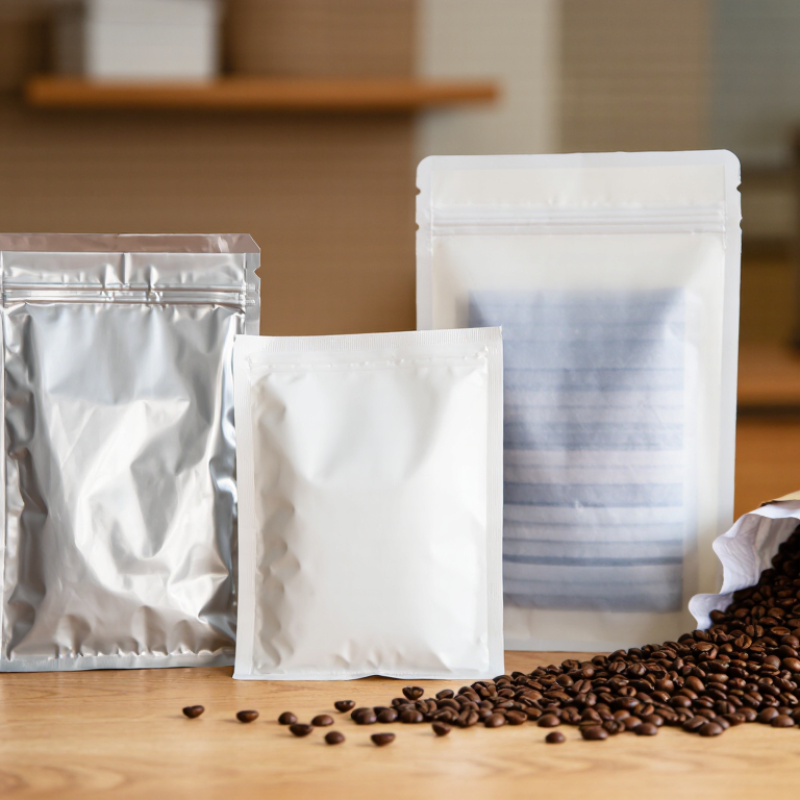
What Makes Coffee Packaging a Reliable Barrier Material?
7 Best Coffee Barrier Materials for Global Buyers
What Makes Coffee Packaging a Reliable Barrier Material?
Coffee packaging must block oxygen, moisture, light, and aroma loss. These threats rarely arrive alone. A warm container, humid warehouse, or weak seal can damage roasted beans quickly. The International Coffee Organization’s 2024 Coffee Development Report highlights coffee’s global supply complexity, making transport protection increasingly important.
The seven common options include aluminum foil laminates, metallized films, EVOH structures, coated paper, PET, polyethylene, and bio-based high-barrier films. Each material performs differently. Aluminum foil offers excellent light and oxygen protection. Metallized films reduce weight, but tiny pinholes may lower performance. EVOH provides strong oxygen resistance, although humidity can weaken it. Paper feels sustainable, yet paper alone is not a dependable barrier.
Reliable packaging depends on the complete structure. Seal strength, layer adhesion, valve design, and storage conditions all matter. ASTM F1249 measures water vapor transmission, while ASTM D3985 measures oxygen transmission. These tests support objective purchasing decisions. Smithers’ 2024 packaging research also identifies lightweighting and recyclable structures as major industry directions.
A low transmission rate looks impressive. It is not everything. In practical packing trials, rough handling can create invisible channels near seals. That assumption is too neat. Global buyers should request test results, aging data, and samples exposed to heat and humidity. The Sustainable Packaging Coalition’s recent guidance also stresses that material claims need full-life-cycle context, not only attractive labels.
7 Best Coffee Barrier Materials for Global Buyers
What makes coffee packaging a reliable barrier material?
The chart uses a 1–10 engineering index based on commonly reported packaging behavior:
oxygen protection, moisture protection, light protection, and aroma retention. Aluminum
foil laminates provide the strongest overall barrier, while EVOH offers excellent oxygen
protection but requires moisture-resistant outer layers. Actual performance depends on
material thickness, structure, seals, temperature, and humidity.
How Aluminum Foil Protects Coffee from Oxygen and Light
7 Best Coffee Barrier Materials for Global Buyers?
How Aluminum Foil Protects Coffee from Oxygen and Light
Fresh coffee is highly sensitive to oxygen, light, moisture, and heat. Roasted beans release carbon dioxide while their aromatic oils slowly oxidize. Aluminum foil offers one of the strongest barriers available for flexible coffee packaging. Its dense metal layer blocks light completely and greatly limits oxygen transmission when the package remains intact.
In practical packaging work, foil is usually laminated with plastic layers. The plastic supports sealing, while the foil provides the main barrier. A common structure may include an outer polymer film, aluminum foil, and an inner heat-sealing layer. This combination helps protect ground coffee during shipping across humid climates and long distribution routes. The sealed edge matters greatly. Even excellent foil cannot compensate for a weak closure.
There is a limitation worth considering. Foil can develop pinholes or tiny cracks after repeated folding, rough handling, or sharp creasing. The damage may be invisible. I have found that a package looking perfect can still lose barrier performance after transport testing. Buyers should examine seal strength, flex resistance, foil thickness, and oxygen transmission data. Barrier results also depend on package size and filling equipment. More foil is not always better. A carefully designed laminate often performs better than a thicker, poorly sealed structure.
How to Choose the Best Coffee Barrier Material for Global Markets
Choosing coffee barrier material for global markets requires more than comparing price. Roasted beans release carbon dioxide, while oxygen, moisture, light, and odors threaten freshness. A suitable structure may use high-barrier aluminum foil laminate, metallized film, or a recyclable mono-material design. Each option behaves differently during filling, sealing, shipping, and storage. Coffee is unforgiving. A small seal channel can flatten aroma within weeks. Test the complete pack, not just the film.
Start with the destination climate and supply route. Humid ports demand stronger moisture resistance. Long sea freight increases exposure to heat and handling. Dark roast coffee may need robust oxygen protection, while lighter roast profiles can show aroma loss sooner. Check seal strength, puncture resistance, printing compatibility, and valve performance. Ask for measured oxygen and water vapor transmission data. Do not rely on attractive marketing claims. Independent laboratory testing is safer.
Sustainability also needs careful judgment. A recyclable structure may simplify recovery but provide less protection in difficult climates. A foil-based laminate can protect exceptionally well, yet its recycling pathway may be limited in some regions. There is no perfect answer. Review local collection systems, food-contact requirements, and importer expectations before choosing. Pilot shipments reveal problems that laboratory tests miss. We should admit this: the cheapest material can become expensive after stale inventory, complaints, or repacking. Select the lightest barrier that protects the coffee reliably.
7 Best Coffee Barrier Materials for Global Buyers? – How to Choose the Best Coffee Barrier Material for Global Markets
| Material / Barrier Layer |
Common Packaging Structure |
Typical Oxygen Transmission
OTR*
(cc/m²/day) |
Typical Water Vapor Transmission
WVTR*
(g/m²/day) |
Main Advantages |
Main Limitations |
Best-Fit Coffee Applications |
Global Market Suitability |
| Aluminum Foil |
PET / Aluminum Foil / PE or PP |
Usually <0.01 |
Usually <0.01 |
Excellent protection against oxygen, moisture, light and aroma loss; strong performance for long sea transport and extended shelf life. |
Not transparent; can crease or pinhole; difficult to recycle when bonded to mixed polymers. |
Premium roasted beans, ground coffee, export packs and products requiring maximum aroma retention. |
Excellent for maximum barrier |
| Metallized PET |
Metallized PET / PE or CPP |
Approximately 0.1–1.0 |
Approximately 0.1–1.0 |
Very good oxygen, moisture and light barrier; lighter and often more economical than foil; attractive metallic appearance. |
Barrier can decline if the metallized layer is damaged; usually not compatible with simple mono-material recycling. |
Retail coffee pouches, single-serve packs and products needing strong barrier with lower material weight. |
Very good balance of barrier and cost |
| EVOH |
PE / EVOH / PE or PP / EVOH / PE |
Approximately 0.1–1.0 when well protected |
Approximately 0.5–3.0 in a finished multilayer |
Excellent oxygen barrier; can support transparent packaging; compatible with high-performance multilayer film designs. |
Oxygen barrier is sensitive to humidity; requires moisture-protective outer layers and precise processing. |
Transparent coffee packs, high-barrier recyclable-design trials and packaging where product visibility is important. |
Strong option where transparency matters |
| High-Barrier PE |
PE / PE, often with a barrier coating or tie layer |
Approximately 1–10 |
Approximately 0.5–3.0 |
Good moisture resistance, flexible sealing performance and potential compatibility with PE recycling streams when designed as a suitable mono-material. |
Usually lower oxygen barrier than foil or metallized structures; performance depends strongly on thickness and coating technology. |
Recycling-oriented pouches, medium shelf-life coffee and markets prioritizing flexible mono-material formats. |
Good for recycling-focused strategies |
| Polyamide (PA / Nylon) |
PA / PE or PET / PA / PE |
Approximately 20–60 |
Approximately 2–8 |
High puncture, tear and impact resistance; useful for durable bags and demanding filling or transport conditions. |
Moderate oxygen barrier compared with foil; absorbs moisture, which can affect dimensional stability and barrier performance. |
Heavy-duty coffee bags, large-format packs and packaging exposed to rough handling or long-distance logistics. |
Best for mechanical durability |
| Coated Paper |
Paper / PE, dispersion coating or functional barrier coating |
Approximately 1–100+ |
Approximately 1–20 |
Strong shelf appeal, printable surface, paper-based appearance and good stiffness; suitable for short-to-medium shelf-life products when properly coated. |
Barrier varies widely; paper alone is not sufficient for long-term coffee aroma and oxygen protection; recycling depends on the coating and local facilities. |
Fresh-roast retail packs, refill bags, short distribution cycles and sustainability-led packaging concepts. |
Good when appearance and fiber content are priorities |
| Silicon-Oxide-Coated Film (SiOx) |
SiOx-coated PET or BOPP / PE or PP |
Approximately 0.1–1.0 |
Approximately 0.1–1.0 |
High oxygen and moisture barrier with a transparent appearance; can provide a premium look without metallic opacity. |
Coating may be vulnerable to flex cracking, abrasion or poor converting conditions; typically costs more than standard films. |
Premium transparent pouches, specialty coffee and packaging where product visibility and high barrier are both required. |
Excellent for transparent premium packs |
Selection guidance: Choose aluminum foil or metallized PET for maximum aroma and shelf-life protection; EVOH or SiOx for transparent high-barrier designs; high-barrier PE when mono-material recyclability is a priority; PA when puncture resistance is critical; and coated paper when printability, stiffness and a paper-based appearance are central requirements.
Technical note: OTR and WVTR values are indicative typical ranges for finished multilayer films under commonly used laboratory conditions. Actual performance depends on film thickness, humidity, temperature, coating quality, sealing, valve design, package geometry and test method. A one-way degassing valve and properly controlled heat seals are also important for roasted coffee packaging.
Conclusion
Coffee Barrier Materials play a vital role in preserving the freshness, aroma, and quality of coffee throughout storage and international transportation. A reliable barrier must limit the entry of oxygen and moisture while blocking light, heat, and external odors that can accelerate flavor loss. Aluminum foil offers strong protection against oxygen and light, making it suitable for demanding packaging conditions. High-barrier plastic films provide flexibility, durability, and efficient sealing, while metalized films offer a practical balance between protection, weight, and cost.
For global markets, selecting the best Coffee Barrier Materials requires evaluating product shelf life, packaging format, transportation conditions, production efficiency, and sustainability goals. The right choice should protect roasted coffee from environmental exposure without creating unnecessary material use or shipping weight. By comparing barrier performance, puncture resistance, seal quality, recyclability, and total cost, manufacturers and buyers can develop packaging that maintains coffee quality from production to the final consumer.

 YPAK PACKAGING